In today's hyperconnected world, cryptography is no longer a niche concept understood solely by mathematicians and cybersecurity experts. It has become the backbone of digital communication, safeguarding data across a spectrum of devices and platforms. From personal gadgets to industrial systems, cryptography ensures confidentiality, integrity, and authentication. As the Internet of Things (IoT) expands, cryptography's role has grown exponentially — but so too has the need for crypto-agility to address emerging threats.
Cryptography in IoT: The Ubiquitous Guardian
The IoT ecosystem is vast, encompassing billions of devices that communicate autonomously to perform tasks and improve efficiency. Each of these devices relies on cryptography to secure its operations. To appreciate the magnitude of this reliance, consider several examples of IoT applications where cryptography is indispensable:
- Credit Card Machines and Point-of-Sale (POS) Systems — Payment terminals exemplify IoT's penetration into everyday life. Cryptographic protocols like the Advanced Encryption Standard (AES) and RSA ensure secure transactions, encrypting sensitive credit card information as it is transmitted between devices. These systems also employ digital signatures to authenticate communication and prevent fraudulent activities.
- Smart Home Devices — From smart locks and thermostats to surveillance cameras, cryptography underpins the security of smart home ecosystems. Secure Socket Layer (SSL) and Transport Layer Security (TLS) protocols encrypt communication between devices and servers, preventing eavesdropping and unauthorized access.
- Wearable Health Devices — Devices such as fitness trackers and medical monitors collect sensitive personal health data. Cryptographic measures ensure that this information is encrypted during transmission and storage, complying with data protection regulations such as HIPAA.
- Industrial IoT (IIoT) — In manufacturing and energy sectors, IoT devices control critical infrastructure. Cryptography prevents malicious actors from tampering with operational data, ensuring the safety and efficiency of these systems.
- Connected Vehicles — Modern vehicles are equipped with IoT capabilities for navigation, infotainment, and safety systems. Public Key Infrastructure (PKI) is often used to authenticate software updates and secure vehicle-to-everything (V2X) communication.
- Smart Cities — IoT enables traffic management, waste disposal, and energy distribution in smart cities. Cryptographic algorithms safeguard data integrity and prevent cyberattacks on these interconnected systems.
Why Crypto-Agility Is Critical
While cryptography remains a robust tool for securing IoT devices, its effectiveness is not static. New vulnerabilities and computational advancements, such as the rise of quantum computing, threaten to render current cryptographic algorithms obsolete. This is where crypto-agility becomes vital.
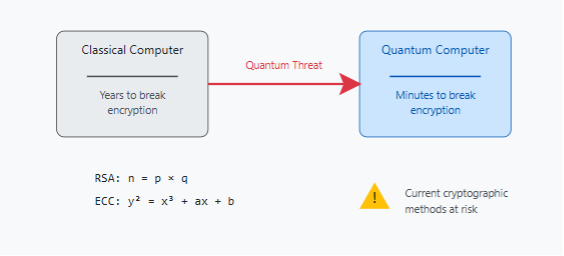
1. The Threat of Quantum Computing. Quantum computers, once fully realized, will possess the computational power to break widely used cryptographic protocols like RSA and ECC (Elliptic Curve Cryptography). Shor's algorithm demonstrates that quantum computers can factorize large numbers exponentially faster than classical computers, rendering current encryption methods vulnerable.
2. IoT's Long Lifespan. IoT devices often have long operational lifespans, sometimes spanning decades. Many of these devices are not designed with the flexibility to update their cryptographic protocols. As threats evolve, the inability to adapt becomes a critical security gap.
3. Increasing Sophistication of Cyberattacks. Attackers are constantly finding innovative ways to exploit vulnerabilities. Static cryptographic systems are more susceptible to such exploits, as they cannot adapt to new attack vectors.
4. Regulatory Compliance and Trust. Evolving regulatory frameworks like the General Data Protection Regulation (GDPR) and California Consumer Privacy Act (CCPA) mandate robust and adaptive security measures. Organizations that fail to implement crypto-agility risk non-compliance, reputational damage, and financial penalties.
Building Crypto-Agility into IoT Systems
Crypto-agility refers to the ability of systems to seamlessly update or replace cryptographic algorithms without disrupting operations. To achieve this, organizations must adopt the following strategies:
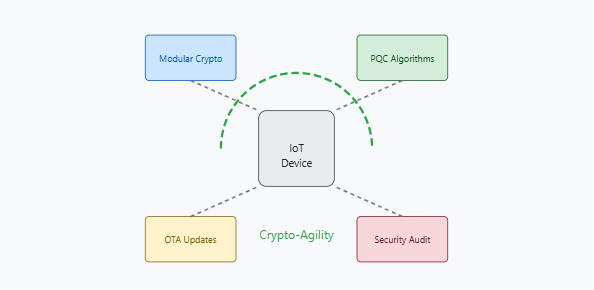
- Modular Cryptographic Architectures — Designing IoT devices with modular cryptographic components enables easy updates and replacements. This ensures compatibility with future algorithms without requiring hardware overhauls.
- Post-Quantum Cryptography (PQC) — Transitioning to PQC algorithms, which are resistant to quantum attacks, is essential. NIST is actively working on standardizing PQC protocols.
- Regular Cryptographic Audits — Conducting routine assessments of cryptographic systems helps identify vulnerabilities and ensure compliance with the latest security standards.
- Secure Over-the-Air (OTA) Updates — Implementing robust OTA update mechanisms allows devices to receive cryptographic updates remotely, minimizing downtime and cost.
- Collaboration and Standardization — Industry-wide collaboration is necessary to establish interoperable standards for crypto-agility. Organizations like the IoT Security Foundation (IoTSF) are working to promote such initiatives.
Looking Ahead: The Next Five Years
The future of IoT security depends on our ability to adapt. Industry guidance increasingly points toward the back half of this decade as the window in which a large share of IoT devices will need to support quantum-resistant encryption. The time to prepare is now — organizations that embrace crypto-agility will not only safeguard their operations but also position themselves as leaders in a rapidly evolving technological landscape.
By proactively adopting adaptable cryptographic measures, the IoT ecosystem can remain secure, resilient, and prepared for the challenges of tomorrow.