Quantum computing is celebrated for its revolutionary potential in fields like drug discovery, climate modeling, and complex optimization. However, alongside this promise lies a rising cybersecurity concern: the ability of quantum systems to disrupt existing cryptographic protections and create entirely new attack surfaces.
Although widespread, fully autonomous quantum attacks have not yet been observed, nation-state actors and sophisticated threat groups are already preparing for a future where quantum advantages can be weaponized. Notably, risks such as Harvest Now, Decrypt Later (HNDL) campaigns — where encrypted data is stolen today and decrypted in the future using quantum computers — are recognized as credible and urgent by major cybersecurity agencies.
According to a joint 2024 factsheet from CISA, NSA, and NIST, organizations must now establish a quantum readiness roadmap to assess vulnerabilities, upgrade cryptographic infrastructure, and work with technology vendors to manage the transition to post-quantum cryptography.
This article explores how quantum-driven cyberattacks could emerge, why they will differ from classical threats, and what board members and CISOs can do today to avoid being blindsided tomorrow.
What Is Quantum Malware?
Quantum malware refers to malicious software designed to exploit vulnerabilities in quantum computing systems or hybrid environments where classical and quantum technologies intersect. Unlike conventional malware that targets files or memory in classical systems, quantum malware could specifically aim to:
- Disrupt qubit operations through noise injection or intentional decoherence.
- Exploit flaws in quantum error correction protocols.
- Target quantum cloud service APIs where classical systems control quantum processors.
- Intercept or steal intermediate data processed between classical and quantum systems.
While these attack vectors remain theoretical, their plausibility increases with the expanding accessibility of quantum platforms. Research into quantum-secure architectures highlights that hybrid systems — those bridging classical and quantum components — will be particularly vulnerable if proper isolation, authentication, and input validation are not enforced.
How Quantum-Based Attacks Could Work
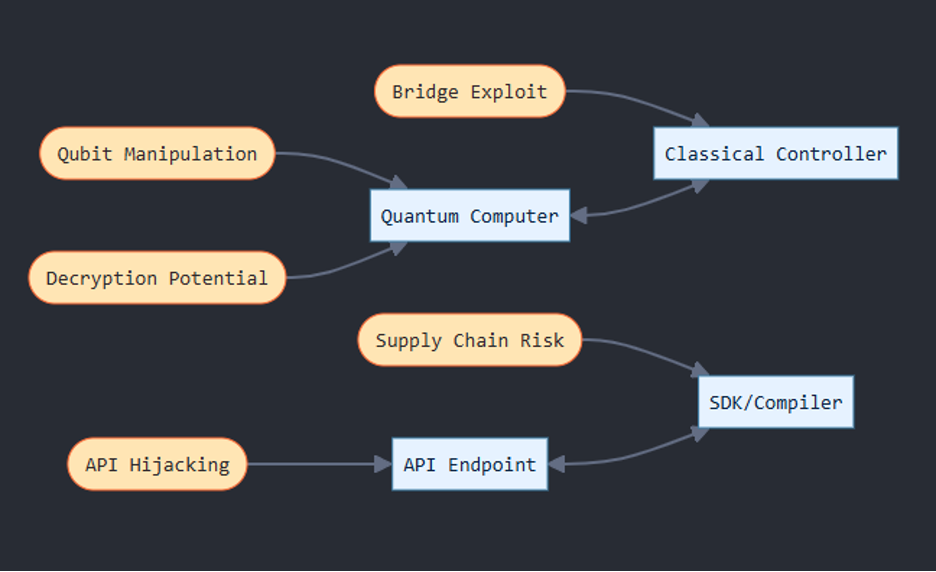
While quantum computers are not yet widespread enough today to become primary attack surfaces, the cybersecurity landscape is shifting rapidly as hybrid quantum-classical systems emerge. Here's how quantum-powered or quantum-targeted attacks could plausibly unfold:
1. Qubit State Manipulation
An attacker could interfere with the quantum state of qubits during computation, introducing noise or applying unauthorized operations that subtly corrupt outputs. In optimization problems, for example, this could lead to degraded routing, financial miscalculations, or decision errors — all without immediate detection. This type of quantum fault injection risk has been discussed conceptually in early studies on quantum control vulnerabilities.
2. Quantum API Hijacking
Services like IBM Quantum, Azure Quantum, and others provide API-driven access to quantum processing units (QPUs). If an attacker gains unauthorized access, they could submit malicious quantum circuits, monitor legitimate computational requests, or harvest metadata about quantum workloads. Cloud quantum API endpoint security has been flagged as a rising concern in NIST's evolving post-quantum security discussions.
3. Hybrid Bridge Attacks
Quantum computers rely heavily on classical interfaces for user input, control, and readout. An attacker could infect classical systems (e.g., workstation control software) and leverage them to interfere with or spy on quantum computations. This mirrors traditional supply chain attacks but extends into quantum environments.
4. Supply Chain Risks
Many quantum SDKs, compilers, and error correction libraries remain open-source and relatively immature. Compromising these software components could allow an attacker to silently corrupt quantum workloads across multiple organizations — a risk made concrete by the SolarWinds attack, which showed how upstream code corruption can cascade across industries.
5. Quantum-Powered Decryption Attacks
Once scalable, fault-tolerant quantum computers are realized, attackers could deploy Shor's algorithm to break widely used classical encryption schemes such as RSA-2048 and ECC. Although such quantum capabilities may still be years away, the cybersecurity threat is already active today under the Harvest Now, Decrypt Later strategy: adversaries systematically collect and store encrypted communications today, intending to decrypt them once quantum computing reaches the necessary power levels. Enterprises handling sensitive data — financial transactions, healthcare records, or government communications — are particularly at risk.
The urgency for organizations to migrate to post-quantum cryptographic algorithms stems from the simple reality that data stolen today could be exposed tomorrow, even if it remains encrypted at rest.
Signs of Emerging Quantum Risk
- Increased scanning of quantum API endpoints.
- Sudden changes in qubit decoherence times during workloads.
- Source code injection in open-source quantum SDKs.
- Stealthy exfiltration of quantum gate logs or circuit topologies.
- Suspicious access attempts to quantum simulators used in R&D environments.
Why Board Members Can't Detect These Threats — Yet
Most quantum systems lack built-in monitoring tools. There are currently:
- No quantum intrusion detection systems (QIDS).
- No forensic methods to inspect qubit histories.
- No baseline behavioral models for quantum workloads.
Moreover, few enterprise security teams include quantum-literate personnel. Even if a quantum attack occurred, the event might be dismissed as a computational anomaly rather than a breach.
What Board Members Can Do Now
Preparation doesn't require quantum expertise, but it does require a risk-aware mindset and proactive collaboration. Here's what forward-thinking CISOs should focus on:
1. Map Your Quantum Exposure Even if you don't run quantum systems, you might use vendors that rely on quantum optimization, share encrypted data now that could be decrypted later, or interface with quantum cloud services via APIs. Audit R&D, analytics, and logistics teams for quantum software use.
2. Harden the Classical-Quantum Bridge Secure classical components that interact with quantum processors: use API authentication and input validation, and isolate quantum controllers from general-purpose networks. Implement dual-authentication for API tokens that invoke quantum circuits.
3. Track Quantum R&D and Standards Follow developments from NIST's Post-Quantum Cryptography Program, ETSI's Quantum Safe Cryptography Initiatives, and the IETF's Post-Quantum Use in Protocols (pquip) Working Group. Create a monthly threat bulletin with updates on PQC developments.
4. Invest in Post-Quantum Cryptography (PQC) Even if quantum malware isn't here yet, quantum decryption will be. Start migrating to NIST-recommended PQC algorithms like CRYSTALS-Kyber and CRYSTALS-Dilithium.
5. Engage with the Ecosystem Work with quantum vendors (IBM, IonQ, Rigetti) to understand their security stack, startups researching QIDS or quantum runtime monitoring, and academic researchers building early-stage detection frameworks. Consider sponsoring university research on quantum malware simulation.
Conclusion: What Makes Quantum Malware So Dangerous?
The biggest threat of quantum malware is invisibility — its ability to operate below the threshold of classical detection tools. By the time most organizations are aware of quantum threats, attackers may already have access to hybrid environments, encrypted datasets, or quantum runtimes.
We are not yet in a world where quantum malware wreaks havoc at scale, but we are fast approaching an environment where the foundations of such attacks can quietly be laid. Forward-looking board members must treat quantum as part of their strategic risk horizon, even if the tech hasn't landed in production. The goal isn't panic — it's proactive readiness.
By investing in post-quantum cryptography, building bridges between security and R&D teams, and mapping early warning signs, organizations can begin hardening their digital terrain before quantum risks become real-world incidents.
References
- National Institute of Standards and Technology (NIST), "Post-Quantum Cryptography Project," 2024.
- European Telecommunications Standards Institute (ETSI), "Quantum-Safe Cryptography Initiatives," 2024.
- Internet Engineering Task Force (IETF), "Post-Quantum Use in Protocols (pquip) Working Group," 2024.
- Cybersecurity and Infrastructure Security Agency (CISA), NSA, and NIST, "Quantum Readiness: Migration to Post-Quantum Cryptography," 2024.