
A dangerous complacency has taken root in the C-suite. A landmark report from IBM and the Cloud Security Alliance revealed a startling statistic: 62% of executives are waiting for their vendors to make them quantum-safe. They expect cloud providers, software vendors, and equipment makers to simply embed Post-Quantum Cryptography (PQC) into their products, which internal teams can then apply like a routine update.
This mindset is a profound and dangerous oversight. Waiting for a vendor-supplied silver bullet ignores the fundamental nature of the PQC transition. It is not a simple patch, but one of the most complex systems engineering challenges organizations have ever faced. Ultimate accountability for protecting data and systems cannot be outsourced.

The Vendor Reliance Gap: Flying Blind Into a Storm
The gap between expectation and reality is alarming. While a majority of leaders are pinning their hopes on vendors, the data reveals a severe lack of internal preparedness. Organizations are flying blind: only 30% having conducted a full cryptographic inventory, and the average enterprise scoring a mere 25 out of 100 on IBM's Quantum-Safe Readiness Index. This dangerous combination of passive waiting and a lack of visibility creates a significant, unmanaged risk.
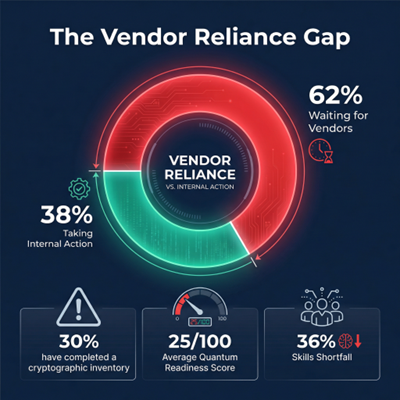
Experts argue that the belief that vendors will provide a seamless fix is a misconception. PQC algorithms are not drop-in replacements; they have larger key sizes and different performance characteristics that demand significant software and hardware changes. As one peer-reviewed study notes, even a rapid migration heavily reliant on SaaS vendors introduces a new vector of risk should those vendors stumble. Cryptography is woven deeply into the fabric of the enterprise — embedded in legacy applications, custom code, and third-party integrations — far beyond the reach of a simple vendor patch.
High-Risk Sectors in the USA: Where the Damage Will Hit First
The quantum threat is not evenly distributed. For several critical US sectors, the risk is existential, and the timeline for action is rapidly shrinking. Let's walk through the industries that should be treating this as a five-alarm fire.
1. Financial Services: A $3.3 Trillion Systemic Risk
The US financial system sits at the epicenter of the quantum threat. A February 2026 report from the Citi Institute paints a devastating picture: a quantum-enabled cyberattack disrupting a single major US bank's access to the Fedwire payment system — the real-time backbone of the Federal Reserve — could put $2.0 to $3.3 trillion of US GDP at risk, equivalent to 10–17% of the entire US economy. This is not a data breach. This is a potential systemic collapse.

The financial sector's exposure is acute because banks rely on cryptographic systems for virtually everything: interbank messaging (SWIFT), transaction settlement, identity verification, and secure communications. A disruption to any of these layers could impair liquidity, freeze payments, and erode confidence — amplifying the initial shock into a cascading national crisis.
The threat extends to digital assets as well. Citi estimates that more than 65% of Ethereum's current supply could be vulnerable to quantum attacks, while Solana's exposure is described as "effectively total" due to differences in transaction design.
What this means for financial leaders: If your institution has not begun a cryptographic inventory of every system touching payments, settlements, and customer data, you are already behind. The migration to PQC in finance will take years — and the clock started ticking long ago.
2. Healthcare: Where Data Theft Becomes a Matter of Life and Death
The healthcare sector is facing a dual crisis of patient safety and data privacy that quantum computing will dramatically amplify. In 2024 alone, there were 677 cyber breaches exposing 182 million patient records globally. Healthcare data is uniquely valuable to adversaries because of its long shelf life — medical histories, genomic sequences, and clinical trial data remain sensitive for decades, making them ideal targets for HNDL attacks.
| Healthcare Vulnerability | Why It Matters |
|---|---|
| Electronic Health Records (EHR) | Massive patient data stores secured with RSA/ECC — prime HNDL targets |
| Internet of Medical Things (IoMT) | Insulin pumps, pacemakers, and imaging systems use lightweight encryption that is nearly impossible to update |
| Telehealth Platforms | Sensitive patient communications transmitted using vulnerable encryption protocols |
| Genomic Databases | Data requiring decades of confidentiality — the ultimate HNDL prize |
| Cloud Healthcare Infrastructure | 47% of healthcare cloud data is classified as sensitive [4] |
The consequences go far beyond data theft. Compromised medical devices could lead to life-threatening situations for patients. Decrypted health data could be used to discriminate against vulnerable populations, eroding public trust in the healthcare system. And HIPAA violations resulting from quantum-enabled breaches could trigger severe financial penalties that dwarf current breach costs.
What this means for healthcare leaders: The FDA, HHS, and CISA have all signaled the need for quantum-resistant solutions. Organizations that still rely on legacy PKI-based systems are sitting on a ticking time bomb. Start with your EHR vendors and medical device manufacturers — they are your highest-risk third parties.
3. Energy & Critical Infrastructure: The Lights Could Go Out
The security of the US power grid, water systems, and telecommunications networks is fundamentally tied to cryptography. Supervisory Control and Data Acquisition (SCADA) systems that manage the energy grid rely on encryption protocols that quantum computers will be able to break. A successful quantum attack on these systems could trigger widespread blackouts, disrupt water treatment facilities, and cripple telecommunications — with cascading effects across the entire economy.
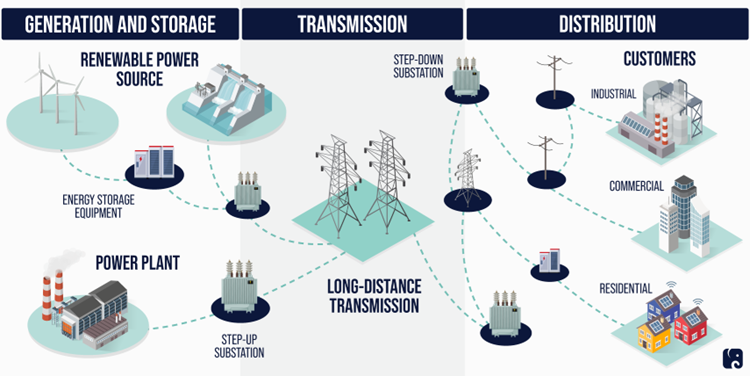
The US energy grid is a particularly attractive target because of its interconnected nature. A breach at a single point can cascade across regions. The Department of Energy's National SCADA Test Bed has been researching quantum-resistant solutions, but the transition for operational technology environments — where hardware lifecycles span 20 to 30 years — will be extraordinarily complex and expensive.
What this means for energy leaders: Unlike IT systems that can be patched relatively quickly, operational technology in the energy sector operates on hardware replacement cycles measured in decades. The time to begin planning quantum-safe upgrades for SCADA and industrial control systems is now, not when the first quantum attack makes headlines.
4. Defense & Intelligence: The Ultimate National Security Threat
For the Department of Defense and the intelligence community, the quantum threat is existential. A hostile nation with a sufficiently powerful quantum computer could potentially decrypt classified military and intelligence secrets, exposing sensitive battlefield communications, weapons system specifications, and covert operations.
"The impact of adversarial use of a quantum computer could be devastating to [National Security Systems] and our nation."
— National Security Agency

President Biden's National Security Memorandum 10 (2022) ordered the entire US government to upgrade its communication systems to PQC "as much as is feasible by 2035" — an acknowledgment that this migration will take over a decade even with the full resources of the federal government behind it. The sheer scale of the challenge — inventorying thousands of applications, coordinating with defense contractors, retraining personnel, and redesigning authentication layers — means that even the most well-resourced organizations face a multi-year journey.
What this means for defense contractors and government suppliers: If you handle classified or controlled unclassified information, your PQC migration timeline is not optional — it is a contractual and national security obligation. Expect PQC compliance requirements to flow down through the defense supply chain in the coming years.
5. Pharmaceuticals & Intellectual Property: Billions at Stake
The pharmaceutical industry invests billions in R&D, and the intellectual property generated — drug formulas, clinical trial data, proprietary manufacturing processes — represents the core value of these companies. A successful HNDL attack on pharmaceutical IP could allow adversaries to steal years of research and bring competing products to market, undermining the entire innovation model that drives the industry.
The World Economic Forum has specifically warned that "stakes are especially high for pharmaceutical and life sciences organizations" because of the long data lifecycles involved. A drug in development today may not reach market for 10 to 15 years — precisely the window in which quantum computers are expected to become capable of breaking current encryption.
What this means for pharma leaders: Your most valuable asset — your IP pipeline — is being targeted today for decryption tomorrow. Prioritize quantum-safe encryption for R&D data, clinical trial databases, and communications with contract research organizations.
The Path Forward: From Passive Waiting to Active Leadership

Instead of waiting, proactive leaders must take ownership. Here is the roadmap:
- Conduct a Comprehensive Cryptographic Inventory. You cannot protect what you cannot see. Map every cryptographic dependency across your organization — applications, protocols, certificates, keys, and third-party integrations. Only 30% of organizations have done this. Be in that 30%.
- Assess Your Risk Posture by Sector. Not all data and systems face the same level of quantum risk. Prioritize based on data sensitivity, retention periods, and the potential impact of compromise.
- Demand PQC Roadmaps from Your Vendors. Engage vendors not as saviors, but as partners. Require them to provide concrete timelines for PQC migration and hold them accountable.
- Build and Execute Your Own Internal Strategy. Vendor roadmaps are necessary but not sufficient. Your organization needs its own PQC migration plan, owned by the CISO and endorsed by the board.
- Start Migrating Now. NIST has released the first three final PQC standards. The technology exists. The standards exist. What's missing is organizational will.
Don't wait for your vendors. Don't wait for a deadline. Act now.
References
- IBM & Cloud Security Alliance, "Secure the Post-Quantum Future," October 2025.
- Biju Mathew, "Why Cryptographic Migration Timelines Are the Real Security Risk," Communications of the ACM, February 9, 2026.
- Citi Institute, as reported by The Quantum Insider, "Citi Puts a Multi-Trillion-Dollar Price Tag on The Quantum Cybersecurity Threat," February 11, 2026.
- Censinet, "Quantum Computing and Healthcare Vendor Risk: Preparing for the Next Technology Revolution," December 18, 2025.
- RAND Corporation, Edward Parker, "U.S.-Allied Militaries Must Prepare for the Quantum Threat to Cryptography," June 6, 2025.
- National Security Agency, "Post-Quantum Cryptography: CISA, NIST, and NSA Recommend How to Prepare Now," August 21, 2023.
- Federal Reserve, "Harvest Now Decrypt Later: Examining Post-Quantum Cryptography and the Data Privacy Risks for Distributed Ledger Networks," 2025.
- World Economic Forum, "Pharma and Life Sciences Must Act Now on the Quantum Threat," September 25, 2025.